By Dr Rebecca Abushena
Senior Lecturer in Retail and MIBT Doctoral College Department Lead
Reflecting upon my own PhD experience which began almost 20 years ago, I remember my very first day and being shown to an office in the forgotten underbelly of The University of Manchester. I settled on that mostly deserted corridor which housed one other PhD student, a few unknowns, and a renowned Professor who, I think, liked the peace and quiet to be able to get on with his research. I could have very easily been inducted onto the PhD programme and subsequently forgotten about on that faraway corridor (as indeed we used to joke that some people, who were still on the payroll, had been!).
Had it not been for my supervisory team who very much made me feel part of an academic family, who knows where my endeavours as a PhD student would have ended. Thankfully, since then, times have changed for the better. Yes, PhD scholarships and the funding landscape in general seems more competitive yet, there are also many areas where progress, particularly around building a sense of doctoral community, is hugely positive. The opportunities for PhD students to get involved in academic life are certainly more plentiful.
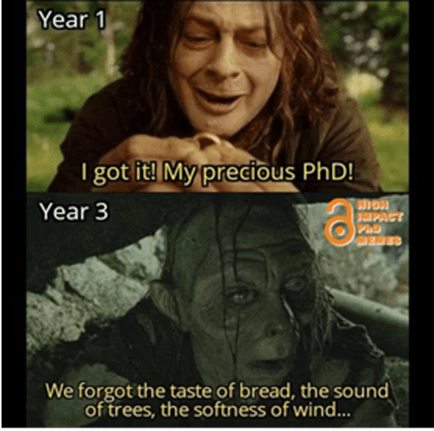
A humorous image of what people *think* PhD study is like (it’s not!) Credit: High Impact PhD memes
You may be reading this blog as one of our current undergraduate or master’s students and wondering if a PhD could be for you. Perhaps you have never thought about a PhD as an option, or feel (as I did), that it is a qualification that only ‘clever’ people can obtain. The truth is, doing a PhD is as much about dedication, perseverance and curiosity as it is being ‘clever’. As doctoral college department lead for MIBT, I see all sorts of people undertake PhD study from high performing master’s students to industry leaders who fancy a change of direction. The thing they all have in common, is an inquisitiveness and passion for learning. We also see a mix of home and international PhD students within MIBT. Third year international PhD student Mahmood Mir explains ‘for any international student considering MIBT, I can confidently say that you will find a supportive, inclusive, and inspiring environment that will help you achieve milestones you never thought possible’.
What are the benefits of a PhD?
Writing an 80,000-word PhD thesis may seem a mammoth undertaking, and whichever way you look at it – it is. But it is also a huge privilege to be given the opportunity to craft this very personal piece of work which will further knowledge in your chosen field. For many, the process also turns out to be a life altering experience with life-long friends made along the way. Second year PhD student in Place Management, Jonathan Hobbs explains the benefits of doing a PhD as ‘contributing to a sea of knowledge and seeing a whole new side to academia and how knowledge is gained and contributed to. It opens the door for a wholly different way of working and sets you up for life with the ability to work at universities across the world’.
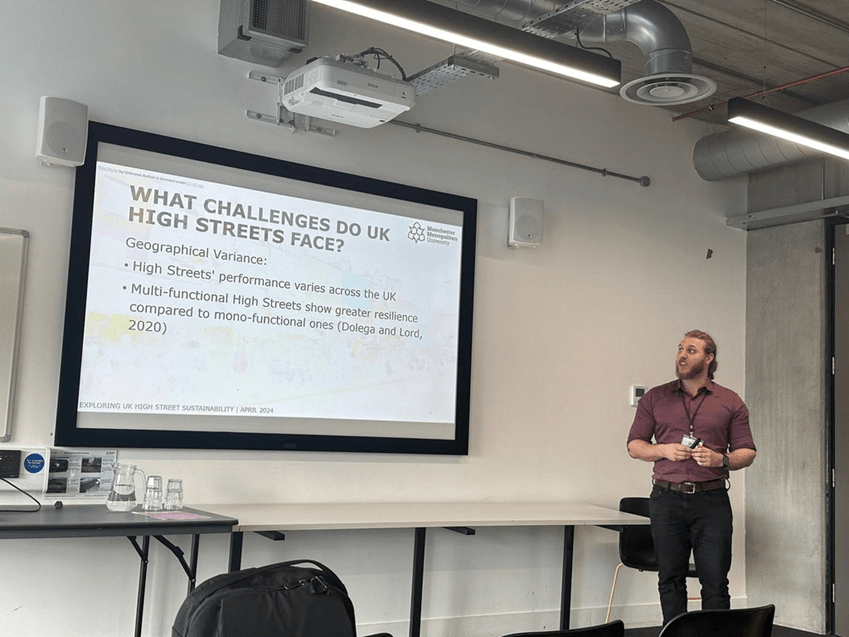
Second year MIBT PhD student Jonathan Hobbs presenting at the Faculty of Business and Law doctoral conference in 2024
Chris Gregory is a fifth-year student also in the field of place management. Chris and Jonathan work mostly away from campus but regularly visit to catch up with their supervisors or attend events. Chris is a very experienced practitioner, who also runs his own place-based consultancy yet explains how undertaking his PhD has developed his skills ‘in academic research, data analysis and the underlying scientific philosophies of my research area and, even at the ripe old age of 52, am excited about new professional goals, possibly linked to academic teaching & publications’.
What type of support is offered for PhD students?
The support offered for PhD students at ManMet is extensive with a range of events offered to support students’ progress, taking place both in person and online. Jonathan further explains ‘MMU has provided continuous support throughout my studies through various teams, including MMU’s Student support base, not to mention the numerous staff who have been helpful throughout the study. A lot of support is provided through the PhD programme itself and various seminars are held initially to ensure everyone is doing well and knows what’s what. Lastly, the PhD students have our own WhatsApp group, which is pretty useful for quick queries or general advice’.
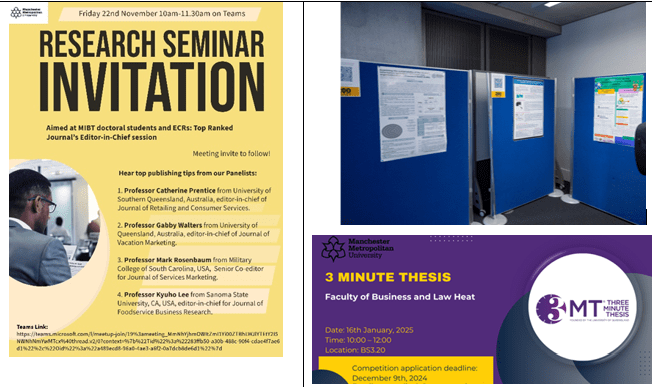
A few examples of the types of activities offered for PhD students including one off seminars, poster sessions and the 3-minute thesis competition.
The first-year doctoral training programme (DRTP) is a key component of the programme. Senior Lecturer Nikos Ntounis is the faculty doctoral training lead and outlines that the ‘DRTP aims to equip PhD students with transferable skills such as communication, critical thinking, developing arguments, academic writing, time management and peer review. Further, the DRTP provides essential training to PhD students and helps establishing a community of learners at this level. The programme aligns with your PhD milestones and supports the completion of these’.
Other supportive initiatives have evolved, particularly since the launch of the Doctoral College ‘The launch of the Doctoral College in January 2024 places PhD students right at the heart of Manchester Met’s research strategy by taking a community-driven approach to embedding students within wider research efforts. The doctoral leadership team, students, supervisors and other academic and professional services colleagues are all working together to make this happen. Initiatives include co-locating students and supervisors in Smarter Working Areas, offering weekly workshops, and engaging with external networks’ (Dr Helen Wadham, Doctoral College Faculty Head- Business and Law).
Achieving the doctorate and future opportunities
Perhaps the most enjoyable part of the process is receiving your doctorate qualification (after a minimum of 3 years if full time or 6 years if part time) which can lead to an academic career or alternatively can enhance students’ prospects in other industry sectors. Dr Amy Ward undertook her viva (the oral defence of the PhD thesis) in February 2024 and reveals that ‘it was a thoroughly enjoyable experience, and I am thrilled with the outcome. My PhD has provided me with so many amazing opportunities to gain experience and helped me set up for the future. I now look forward to securing a lecturer position where I can continue my research and teaching’.
Interested? More about our application process….
The best way of finding out more about applying for a PhD is to visit the website here and check out the process along with our minimum entry requirements. One of the first steps of making an application to do a PhD is to contact a potential supervisor from within the department. Discuss potential topics with them and allow them to help you refine your ideas ready to make an application. Dr. Maher Elmashhara is a lecturer in marketing with a track record of supporting potential applicants from the early stages. He explains ‘when I receive a PhD proposal, my approach is to provide constructive feedback, often focusing on how to make the proposal more relevant and appealing. I emphasize the importance of investigating critical research questions and clearly articulating what the research aims to achieve, both at the theoretical level and in terms of managerial implications. I’m also happy to arrange online meetings with potential candidates when needed. These discussions are incredibly valuable, as they allow for deeper brainstorming and a more interactive exchange of ideas.’
So, if you have an idea for a PhD topic in marketing, international business, tourism or place management/marketing it is likely we have a supervisor working in one of these areas who can support you. To find out more about our supervisors and the areas of research they work on have a look at this webpage.
For further information or an informal chat please contact me: r.abushena@mmu.ac.uk
You can also find out more about undertaking a PhD, including its perks and challenges, via MIBTalk’s episode: ‘The PhD Unpacked’. Listen now:


 MARKETING, INTERNATIONAL BUSINESS AND TOURISM
Leave a comment