Reflections on Camp Digital 2022
By Jordan Price, MSc Digital Marketing Communications student 21/22
Are consumers of technology responsible for the devastating impacts of a damaged planet. Or are we simply building a platform for communication in a world where humans crave relationships?
The answer? Both.
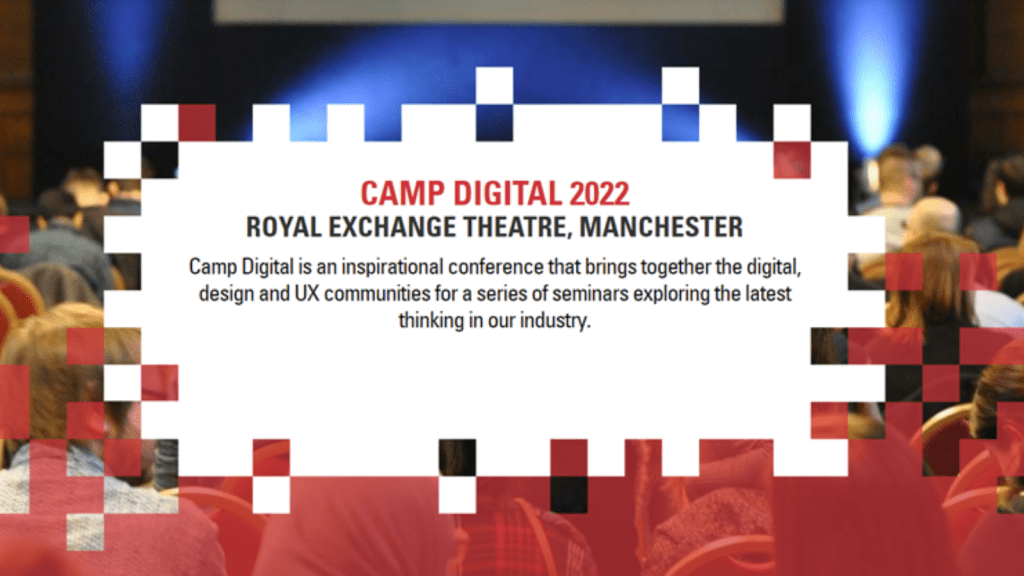
After a couple of years of social isolation, it felt like a very special opportunity to attend Camp Digital 2022 – a conference uniting digital, design and UX communities to encourage collaboration and creativity.
Various industry experts contributed their opinions to ongoing conversations about the impact of the internet as we know it. The conference provoked controversy, inspiration, and pure sensory explosion (yes, it was just as sensational as it sounds!)
“Just Enough Internet”
Rachel Coldicutt – social technology expert, kickstarted the day offering her opinions on “Just Enough Internet”.
Have you ever used a tool that was specifically made for one purpose, but used it for another? Did you know that Listerine was originally invented as anti-septic? And Play-Doh was invented as a wallpaper cleaner? Well, the internet was invented for military purposes, and now we use the technology for communication, business, and research.
Many researchers from Oxford, Harvard and Cambridge have recently contributed to research surrounding the ethics of social interactions on the internet and the challenges associated with having an online presence. Mental health, cyberwar, monopolisation and security are just a few mentioned throughout various studies – all of which the internet was not intended to be used for.
Coldicutt added to these conversations, highlighting “adaptation as a means of resistance.” I was just as confused about this term until she went on to remind us of the advancement of social media and the design of the internet, with its purpose to connect. Think of the internet as an ethical marketplace for building relationships and real connections, instead of a consideration for where you can next make money. Although this was presented in the context of government entities, it’s a lesson which marketers, particularly those dealing with customer relationships, can gain valuable guidance from.
“Earth Experience Design”
Speaking of ethical consideration and connection, we next heard from Gerry McGovern.
“We used to be consumers. Now we’re devourers” – Gerry McGovern
14,000 litres of water to make a smartphone.
190,000 litres of water to make a laptop.
Running a smartphone for 1 year can lead to 5kg of carbon emissions.
This incredibly unsettling, eye-opening, uncomfortable, astonishing and extraordinary speech from Gerry McGovern – Author of World Wide Waste took the entire room by surprise after beginning with a startling list of numbers, some of which are featured above.
It is (hopefully) no shock to hear that the digital industry is exceptionally resource intensive. However, the largest contributions to our ongoing destruction of this planet include the energy required to power devices, and the physical devices themselves (including both the manufacturing process and the disposal of electronics). McGovern provided insight into the materials used to create such products, some of which you would be surprised to find out are toxic (e.g. mercury, lead, phthalates etc.). Furthermore, the human race extracts 100 billion tonnes of materials from the earth every year, with this figure growing to a predicted 170 billion tonnes.
If you were thinking about clearing out some of your unwanted files or limiting your time making TikTok videos (it’s ok, we’re all guilty), now’s probably a good time! As digital communicators we’re so used to making things easier for the user, but really, we’re only making it easier for users to kill the planet. It’s crucial that we all use less. Fewer new devices, less unnecessary tracking of analytics and smaller websites… Even if this means having to convince your boss not to post that cute cat falling off a tree meme to reach millennials for your new ‘grow your own houseplant’ product!
“A Human-Centred Future for Work”
Whilst many of us instantly think of customers when the phrase “digital services” is mentioned, a stable and practical working environment is equally as crucial. Think about your current job or the process involved in finding employment. Would you say it’s easy? Practical? Enjoyable? Many don’t tend to think so.
Sharon O’Dea and Hanna Karpi both advocate for human-centred design in the workplace, reminding digital employers everywhere that our industry should be flexible and transformative. Both leading professionals spoke about discovery and research being essential tasks involved in the design of a human-centred future, specifically emphasizing technology and the use of tools (perhaps too many)?
Their framework (shown below) has been built based on research stating that overwhelm and frustration is often present in the workplace due to the amount of tools a digital technologist is expected to use in order to go about their day-to-day tasks. They asked us to consider:-
Means – Are all the digital tools you’re using necessary?
Opportunity – Are there opportunities to use all of the tools?
Motive – Do people (specifically employees) feel like using these tools are worth it?
Does the following process look complicated to you?
- Brainstorm content ideas using One Note
- Update staff meeting to provide feedback on content using Google Calendar
- Further engage with staff members using Office Tools
- Create content using Canva
- File content using Google Drive
- Schedule content using Hootsuite
- Monitor content using a CRM platform
- Produce a time report using Excel
… etc. etc. etc.
It’s too much!
Let’s create a streamlined, simplified, and integrated workplace to encourage employees to be excited about their work, and to ensure processes don’t intimidate. Invest in digital strategy and the creation of a personalised dashboard for your business, and don’t forget… Digital isn’t the answer to everything!!
Last, but certainly not least, “Less Thinkering, More Tinkering”
Gavin Strange – Director and designer at Aardman, presented one of the most colourful and extravagant speeches I’ve ever experienced. He instilled the message digital entrepreneurs shouldn’t be afraid to take risks or experiment. Known for his passion projects under the name ‘JamFactory’, Gavin certainly isn’t a stranger to taking a risk.
Whilst observing the room throughout this show (I think it’s safe to confidently call this keynote a performance), it was incredible how mesmerized everyone seemed to react to his energetically charged message of motivation.
In order to achieve your goals and take control of your career, it’s vital to take risks and pick apart the lessons you’ve learnt along the way. Don’t be afraid to make mistakes, don’t feel hopeless when you receive a ‘no’, and definitely don’t give in to the smokescreen of just doing what everyone else does.
Gavin continued to speak in detail about being a ‘realistic idealist’ where it’s important to find the balance between what is important to you, and what the process involves to achieve these goals. Finding the time to make these goals become a reality can be the biggest challenge in succeeding, so it’s crucial to find the source of where you get the most energy from and how to materialise this passion into your art.
This keynote was truly passion-filled, insightful and intense in the best way.
Be unique. Be you.


 MARKETING, INTERNATIONAL BUSINESS AND TOURISM
Leave a comment